Minneapolis Rental Market: What You Need to Know
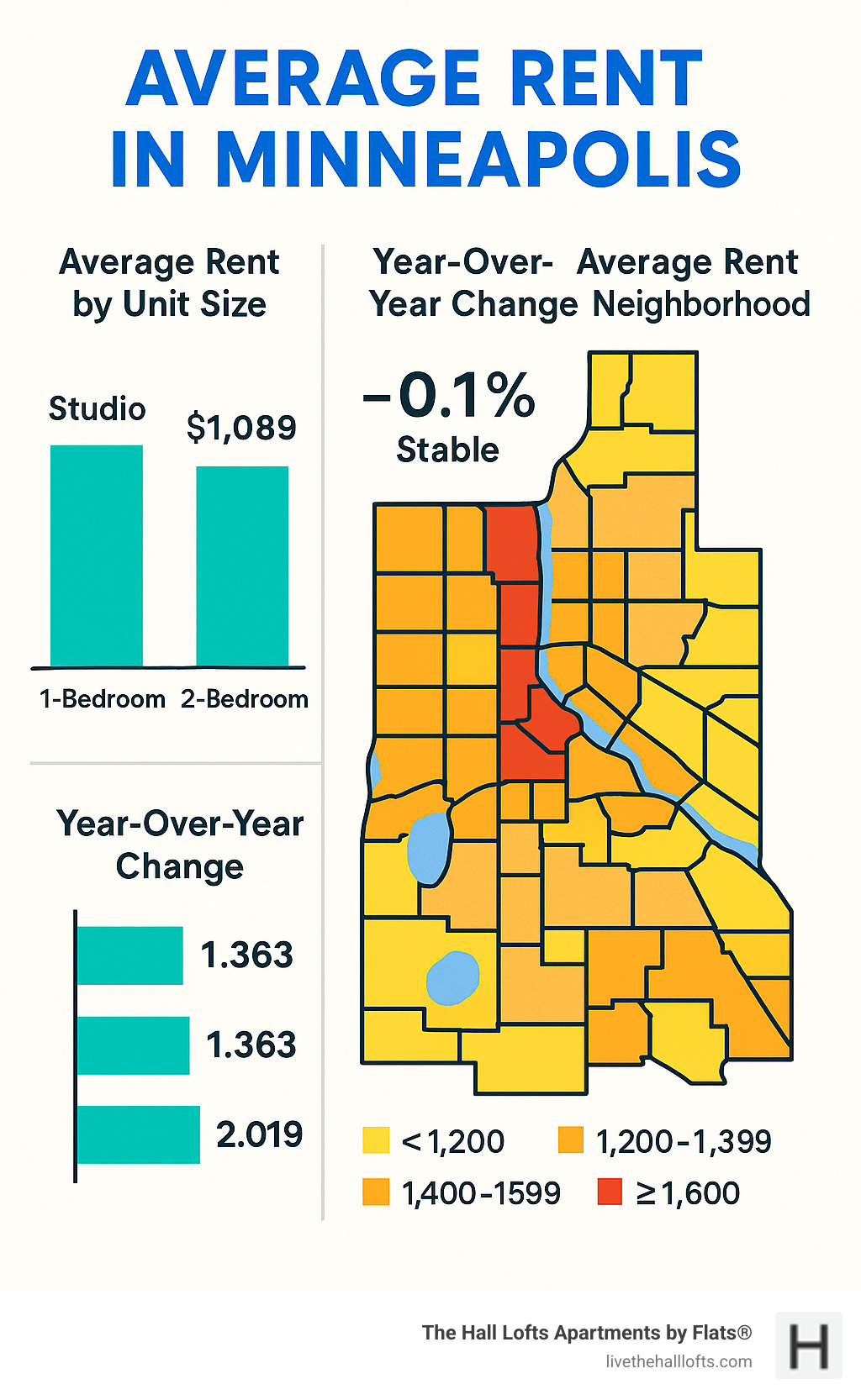
The average rent in Minneapolis is approximately $1,363 per month as of 2025, which is about 12% lower than the national average of $1,556.
| Rental Market Snapshot | Minneapolis, MN |
|---|---|
| Average Rent | $1,363/month |
| Studio Average | $1,089/month |
| 1-Bedroom Average | $1,363/month |
| 2-Bedroom Average | $2,019/month |
| Average Apartment Size | 775 sq ft |
| Renter-Occupied Homes | 52% of households |
| Year-Over-Year Change | -0.1% (stable) |
Whether you're relocating to the Twin Cities or considering a move within Minneapolis, understanding the rental landscape is essential for making informed decisions about your next home. The average rent in Minneapolis varies significantly depending on location, apartment size, and amenities—with neighborhoods like North Loop commanding premium prices while areas such as Hale offer more budget-friendly options.
Minneapolis stands out in the Midwest rental market for its unique blend of urban convenience and relative affordability compared to coastal cities. The rental market has remained remarkably stable over the past year, with prices changing by less than 1% despite nationwide inflation pressures.
The city's rental housing stock ranges from converted warehouses with industrial charm to modern high-rises with luxury amenities. With over 94,000 renter-occupied households representing 52% of the city's housing, Minneapolis has a robust rental market with options for nearly every lifestyle and budget.
Snapshot of the Minneapolis Rental Market
Let's take a closer look at what's really happening in Minneapolis right now. With over 2,200 active rental listings throughout the city, you've got plenty of options to explore—whether you're looking for a cozy studio or a spacious family apartment.
The current average rent in Minneapolis
Right now, the average rent in Minneapolis sits at $1,363 per month according to CoStar Group's latest market reports. This figure represents the median across all neighborhoods and apartment types, which gives you a more realistic picture than a simple average that can get thrown off by ultra-luxury penthouses or unusual bargains.
When we factor in inflation using Consumer Price Index adjustments, Minneapolis renters are actually getting a pretty good deal compared to many growing cities. While the dollar amount on lease agreements has inched up, the actual purchasing power needed to rent here hasn't jumped dramatically like we've seen in coastal markets.
As rental market analysts at Rentometer recently noted: "Minneapolis maintains its position as a balanced rental market in the Upper Midwest, with diverse housing options across its unique neighborhoods. Median rents reached $1,144 in 2019 and have followed a steady, moderate growth pattern since."
Year-Over-Year & Month-to-Month Shifts
One thing that makes Minneapolis stand out is its remarkable stability. Year-over-year rent changes hover around just 1.5%, which is actually below inflation—meaning in real terms, rents have essentially gotten slightly more affordable.
If you're timing your move, keep in mind the seasonal patterns here. Rents typically dip about 3.4% during winter months compared to summer peaks. That makes November through February potentially smart times to sign a new lease if you can brave apartment hunting in the snow!

It's worth noting that citywide averages don't tell the whole story. Some neighborhoods march to their own beat—studio apartments near Calhoun Isles jumped a whopping 42% year-over-year, while similar units around the University of Minnesota dropped by 57% during the same period. This shows why understanding neighborhood-specific trends matters when apartment hunting.
How Much Apartment Space You Get for Your Dollar
The typical Minneapolis apartment offers about 775 square feet of living space, though this varies widely depending on what and where you're renting. Across the city, you'll pay around $2.12 per square foot on average, though prime spots in trendy neighborhoods like North Loop (where The Hall Lofts is located) can command over $3 per square foot for their unique character and amenities.
Here's the breakdown of what your money typically gets you in Minneapolis:
| Unit Type | Average Size | Typical Price Range | Price Per Sq Ft |
|---|---|---|---|
| Studio | 465 sq ft | $871 - $1,282 | $2.35 - $2.75 |
| 1-Bedroom | 663 sq ft | $977 - $2,051 | $1.95 - $2.29 |
| 2-Bedroom | 1,015 sq ft | $1,500 - $2,695 | $1.85 - $2.38 |
| 3-Bedroom | 1,217 sq ft | $2,345 - $3,095 | $1.92 - $2.54 |
Here's an interesting tidbit: the price per square foot actually tends to decrease as apartments get bigger. This means larger units often give you more bang for your buck in terms of space, even though the total monthly rent is higher. Something to consider if you're debating between a one-bedroom or splitting a two-bedroom with a roommate!
Average Rent in Minneapolis by Apartment Size
Finding your perfect Minneapolis apartment isn't just about location—size matters too. Let's explore what you can expect to pay across different apartment types in the city, and what each option offers.
Studios: Budget Friendly Starts
At around $1,089 per month, studio apartments offer the most affordable entry point into Minneapolis living. Averaging about 465 square feet, these cozy spaces make up roughly 20% of the city's rental inventory. They're particularly popular with students just starting out, young professionals building careers, and anyone looking to keep housing costs manageable.
Studios let you live in neighborhoods that might otherwise stretch your budget. In artsy Whittier, for instance, you might snag a studio for around $871, while the same space in lakeside West Calhoun would run closer to $1,282—quite a difference!
What many renters love about warehouse conversions (like those at Pet-Friendly Loft Apartments) are the soaring ceilings and industrial touches that make these spaces feel much larger than their square footage suggests. The character and history baked into these walls often attracts creative spirits who appreciate design with a story.
One-Bedrooms: The Sweet Spot
One-bedroom apartments truly dominate the Minneapolis rental landscape, making up nearly half (47.7%) of available units. The average rent in Minneapolis for these spaces sits at $1,363 for about 663 square feet—explaining why they're often called the market's "sweet spot."
These versatile spaces appeal to everyone from young professionals to empty nesters looking to downsize. Their popularity explains why you'll find them in virtually every neighborhood and building type across the city.
Location dramatically impacts what you'll pay for that one-bedroom dream pad:
- Downtown West commands premium prices around $2,228
- North Loop's hip factor translates to about $1,891
- Whittier offers more moderate options at $1,148
- Camden provides budget-friendly choices around $950
This price variation highlights an important truth: in Minneapolis, where you live can matter more than how much space you have.
Two-Bedrooms: Roommate & Family Appeal
Two-bedroom units average $2,019 monthly for approximately 1,015 square feet, representing about 19% of Minneapolis rentals. These spaces work beautifully for roommates splitting costs, small families needing extra space, or remote workers requiring a dedicated home office.
The math often works out nicely for shared living—two friends splitting a two-bedroom typically each pay less than they would for individual one-bedrooms, while enjoying more common space to boot. Smart economics!
Family-friendly neighborhoods like Hale and Keewaydin offer two-bedrooms starting around $1,500, while luxury seekers in North Loop or Downtown East might spend north of $4,000 for premium finishes and amenities.
Three-Bedrooms & Larger
Making up about 13% of the rental market, three-bedroom apartments average $2,351 monthly for 1,217 square feet. Since the pandemic shifted work patterns, these larger spaces have seen increased demand as renters seek dedicated office space within their homes.
These generous floorplans particularly appeal to multi-generational households and families with children who need room to spread out. The most budget-friendly options tend to cluster in neighborhoods like Ventura Village and Holland.
At the opposite end of the spectrum, premium properties in desirable Linden Hills have seen remarkable price jumps—some two-bedrooms skyrocketed 160% year-over-year to $4,095.
To comfortably afford the average three-bedroom without spending more than the recommended 30% of income on housing, a household needs to earn approximately $94,000 annually.

If you're drawn to spaces with character, the Lofts in Minneapolis offer that perfect blend of historic charm and modern convenience that many renters find irresistible.
Neighborhood Price Map: Highs, Lows & Hotspots
Stroll through Minneapolis and you'll quickly find that each neighborhood tells its own rental story. From the luxurious lofts of North Loop to the budget-friendly apartments of Hale, your address dramatically impacts both your lifestyle and your wallet.
Most Affordable Pockets of the City
Looking to stretch your dollar further? Minneapolis offers several neighborhoods where renters can find genuine value without sacrificing quality of life.
The southeastern neighborhoods of Hale, Keewaydin, Minnehaha, Morris Park, and Wenoah stand out as budget champions, with average rents hovering around $977 monthly. That's a refreshing $386 below the average rent in Minneapolis! These communities offer a more residential feel while still providing good access to the city's amenities.
Whittier has emerged as a favorite for those seeking character and affordability in one package. With one-bedrooms averaging $1,148, the neighborhood offers charming older buildings and converted spaces reminiscent of Lofts in Minneapolis but at gentler price points. The area's artistic vibe and diverse dining scene make it feel like a hidden gem.
The Camden area in North Minneapolis represents another affordable frontier, with one-bedrooms averaging just $950. Similarly, Holland and Ventura Village offer rentals in the $950-$975 range, making them appealing options for budget-conscious renters who still want to enjoy city living.
Most Expensive Enclaves
At the opposite end of the spectrum, several Minneapolis neighborhoods command premium prices that reflect their desirability and amenities.
The North Loop stands tall as the city's luxury leader, with some premium one-bedroom apartments fetching an eye-watering $5,081 monthly. This former warehouse district has transformed into a vibrant urban playground where historic architecture meets modern luxury. Buildings like The Hall Lofts exemplify this blend, offering authentic industrial character alongside contemporary comforts.
Downtown East has established itself as another high-end enclave, with one-bedrooms averaging around $2,250. The university-adjacent neighborhoods of Dinkytown, Marcy-Holmes, and Prospect Park East River Road all hover around the $2,051 mark, catering to a mix of professionals and well-heeled students.
Cedar Isles-Dean ($2,069) and the Warehouse District ($2,063) round out the city's luxury rental landscape. These areas offer a compelling package of walkability, dining options, and sophisticated urban living that many residents find worth the premium.
Where Renters Are Flocking
Rental listing data reveals clear patterns in where Minneapolis renters are gravitating. Not surprisingly, the North Loop tops the popularity charts despite its higher average rent in Minneapolis of $1,891. The neighborhood's walkable streets, trendy restaurants, and converted warehouses create an irresistible urban vibe that many find worth the premium.
Uptown Minneapolis continues to draw renters with its average rent of $1,536, offering a vibrant mix of nightlife, retail, and recreation centered around the Chain of Lakes. Downtown proper ($1,635) appeals to those who prioritize proximity to the city's business district and cultural venues.
Loring Park, with its mix of historic and modern buildings surrounding its namesake green space, consistently ranks among the most-searched neighborhoods. Meanwhile, Whittier proves that affordability and popularity can go hand-in-hand, with its $1,148 average rent making it accessible to a wide range of renters.
Interestingly, the University of Minnesota area experiences the city's highest turnover rate, creating a perpetual cycle of openings that keeps the market dynamic. Similarly, Downtown West boasts the highest concentration of luxury high-rises, appealing to those seeking amenity-rich vertical living.
What's particularly telling is that popularity doesn't always correlate directly with price. Many renters prioritize neighborhood character, convenience, and overall lifestyle fit above pure luxury, creating vibrant communities across various price points throughout the city.
Minneapolis vs Nearby Cities & the Nation
When you're apartment hunting, knowing how the average rent in Minneapolis stacks up against neighboring cities can help you make smarter choices about where to live. Let's take a closer look at how Minneapolis compares both regionally and nationally.
How Minneapolis Stacks Up Regionally
Here's something interesting: the average rent in Minneapolis ($1,363) is actually 4.3% lower than the broader Minneapolis-St. Paul metro area median of $1,472. This flips the script on what we typically see in major cities, where urban cores usually command premium prices compared to their suburbs.
When we look at nearby communities, the differences become even more apparent:
St. Paul sits at $1,431, about 5% higher than Minneapolis. Head to the suburbs and you'll find Maple Grove at a steep 38% premium ($1,875), while Eden Prairie tops the list at $1,905—a full 40% higher than Minneapolis proper. Some suburbs do offer better deals, though: Brooklyn Park ($1,285) and Bloomington ($1,251) both come in slightly below Minneapolis rates.
Why the higher suburban prices? These communities often feature newer construction, larger floor plans, and family-oriented amenities. But don't forget to factor in transportation costs—living in the city core like North Loop might mean you can ditch your car payment and insurance, potentially saving hundreds each month.
"Minneapolis rent is 4.3% lower than the metro-wide median of $1,472," according to Apartment List's analysis. "This creates opportunities for value-conscious renters who want urban amenities without paying a premium."
Average Rent in Minneapolis vs National Picture
On the national stage, the average rent in Minneapolis positions our city comfortably in the middle of the pack. We rank as the 54th most expensive large city in the U.S. for renters, according to recent data.
At $1,363, Minneapolis runs about 12% below the national average of $1,556—good news for your wallet! This affordability advantage has helped attract young professionals and businesses looking for skilled workers without the housing cost pressures seen in coastal markets.
Among Midwestern cities, Minneapolis lands roughly in the middle:
- Chicago generally demands higher rents, especially in trendy neighborhoods
- Milwaukee offers more budget-friendly options across most unit types
- Kansas City remains significantly more affordable
- Denver (though technically not Midwest) commands substantially higher prices
Our city's strong job market, with unemployment consistently running below national averages, helps maintain healthy rental rates while still preserving relative affordability compared to coastal cities.
For more detailed statistics on Minneapolis rental trends, check out the Department of Numbers Residential Rent Statistics which provides comprehensive data on historical rent patterns.
For those drawn to Minneapolis' unique blend of urban amenities and Midwestern practicality, neighborhoods like North Loop offer the perfect balance—historic warehouse charm with modern conveniences, exemplified by communities like The Hall Lofts, where industrial character meets contemporary living.
What Drives Rent Prices in Minneapolis?
Ever wonder why the average rent in Minneapolis varies so much from one neighborhood to the next? Let's unpack the key factors that shape rental prices across the city - from job markets to seasonal shifts.
Minneapolis has a remarkably dynamic rental market, influenced by several interconnected forces that create the neighborhood-by-neighborhood price variations we see today.
The city's robust employment landscape plays a huge role in rental demand. With powerhouse companies like Target, Best Buy, and 3M headquartered in the metro area, stable jobs create steady housing needs. Before the pandemic, Minneapolis enjoyed an unemployment rate of just 3.1% - well below the national average. While COVID temporarily disrupted this pattern, the job market has bounced back impressively, maintaining healthy demand across all price points.
New construction significantly impacts what you'll pay as well. Areas experiencing building booms, like parts of Northeast Minneapolis, have seen more modest rent growth as supply expands to meet demand. Meanwhile, neighborhoods with limited development opportunities - like the historically protected North Loop where The Hall Lofts is located - naturally maintain stronger rental values due to their fixed supply of unique spaces.
Location advantages create clear price premiums across the city. Properties near the Chain of Lakes or with Mississippi River views can command up to 25% higher rents than similar units just blocks away. Similarly, apartments within walking distance of light rail stations or major bus routes typically fetch 5-15% more than comparable units with less convenient transit access.
The amenities race also drives pricing. Buildings offering rooftop decks, fitness centers, pet spas and other lifestyle perks can justify higher rents than basic properties nearby. The premium for in-unit laundry alone can range from $75-150 monthly in older buildings where it's not standard.

Don't underestimate the impact of Minnesota's distinctive seasons on rental pricing. The market follows predictable patterns tied to our climate, with peak rental season occurring during the warmer months (May-August) when moving is more pleasant and student turnover peaks. Winter months (November-February) typically see softer demand and slightly lower prices - creating opportunities for bargain-hunters willing to brave a cold-weather move. According to RentHop data, this seasonal swing averages about 3.4% between summer highs and winter lows.
Policy developments also shape the market. Recent debates around rent control and stabilization measures have created some uncertainty among property owners and developers. While Minneapolis hasn't implemented comprehensive rent control, the ongoing conversation influences investment decisions that ultimately affect supply and pricing.
The trend toward remote work has shifted neighborhood preferences as well. Areas that offer more space and character - like warehouse conversions in the North Loop - have seen increased interest from renters seeking inspirational home office environments rather than just proximity to downtown offices.
Understanding these factors helps explain why the average rent in Minneapolis varies so dramatically across the city, and why some properties command premium prices while others offer relative bargains.
Renting Facts & FAQs for 2025
Looking to make Minneapolis your new home? These rental facts and answers to common questions will help you steer the local market with confidence in 2025.
FAQ #1 – What percentage of households rent vs own?
Minneapolis is very much a renter's city! A solid 52% of households (that's 94,741 homes) are occupied by renters, with owners making up the remaining 48%. This renter majority isn't just a number—it's created a vibrant, diverse rental market with plenty of options for every lifestyle and budget.
This high percentage of renters means property managers and landlords truly understand what renters need and want. They've built their businesses around serving this community. It's worth noting that Minneapolis's 52% renter rate significantly outpaces the Minnesota state average of 29%, reflecting the city's more urban character compared to the rest of the state.
FAQ #2 – What salary do I need to afford the city's average rent?
The classic financial wisdom suggests spending no more than 30% of your gross income on housing. With the average rent in Minneapolis sitting at $1,363, you'd need to earn about $4,543 monthly or $54,516 annually to comfortably afford a typical one-bedroom apartment.
Of course, your needs might vary depending on the space you're looking for:
For a cozy studio, you'd need around $43,560 yearly. If you're eyeing a spacious two-bedroom at about $2,019 monthly, your income should be roughly $80,760. And those three-bedroom units? Plan on needing about $94,040 annually.
This explains why roommate arrangements are so popular here! Splitting that two-bedroom brings each person's share down to about $1,010 monthly, requiring an individual income of just $40,400—much more manageable for many young professionals.
FAQ #3 – How many active listings are on the market right now?
As 2025 gets underway, Minneapolis boasts approximately 2,200 active rental listings across different platforms and property types. This healthy inventory gives you reasonable options, though you'll still want to move quickly for those highly desirable neighborhoods and apartment styles.
The distribution varies significantly across the city. Downtown West, the Warehouse District, and North Loop have the highest concentration of available units. The University area sees predictable turnover waves around semester changes. If you're hunting for a single-family rental home, you'll find more options in residential neighborhoods like Nokomis and Kenny.
Timing matters too! Rental availability follows clear seasonal patterns, with the highest number of options appearing in summer months (especially June and July) when leases end and people relocate more frequently.
For Minneapolis renters needing additional support, these resources can be incredibly helpful:
- HousingLink for affordable housing searches
- Minneapolis Public Housing Authority for subsidized housing information
- HOME Line for free legal advice specifically for Minnesota renters
- Minneapolis Rental Housing Resource Center for renter rights information
The Hall Lofts Apartments by Flats® offers a unique blend of historic warehouse character and modern urban living in the North Loop. With features like spacious layouts, industrial design elements, and pet-friendly policies, these apartments provide the perfect balance of Minneapolis charm and contemporary comfort.
Conclusion
Finding your perfect Minneapolis apartment doesn't have to be overwhelming. With the average rent in Minneapolis sitting at $1,363, our city offers a refreshing blend of urban living without the sky-high prices you'll find in coastal metros.
The stability we've seen in rental prices over the past year (with less than 1% change) gives renters some much-needed predictability in today's economy. Whether you're hunting for a cozy studio in Whittier, a spacious two-bedroom in Hale, or a character-filled loft in North Loop, Minneapolis neighborhoods offer something for every lifestyle and budget.
What makes our rental market special is its diversity. The dramatic price differences between neighborhoods—from the affordable $977 average in Hale to the premium $2,000+ in downtown districts—means you can strategically choose where to compromise and where to splurge. Want more space? Head slightly further from downtown. Craving walkability and nightlife? You might choose to sacrifice some square footage for that perfect location.
For those drawn to Minneapolis' unique character, The Hall Lofts Apartments by Flats® captures the city's spirit perfectly. These thoughtfully renovated warehouse apartments honor the North Loop's industrial heritage while offering all the modern comforts you'd expect—in-unit laundry, pet-friendly policies, and contemporary finishes that make coming home a pleasure every day.
As you steer your apartment search, timing matters too. Winter hunts often yield better deals, while summer brings more options. And don't just focus on the headline rent number—consider what you're getting in terms of space, location, and included amenities.
Whether you're new to the Twin Cities or a longtime resident ready for a change of scenery, Minneapolis welcomes you with a rental market that's refreshingly straightforward and full of character—just like the city itself. Explore layouts that fit your style and budget at The Hall Lofts and find what makes Minneapolis living so special.