Why Sustainable Living Matters in Modern Apartments
Eco friendly apartment buildings combine energy-efficient design, sustainable materials, and healthy living spaces to reduce environmental impact while improving resident comfort and wellness.
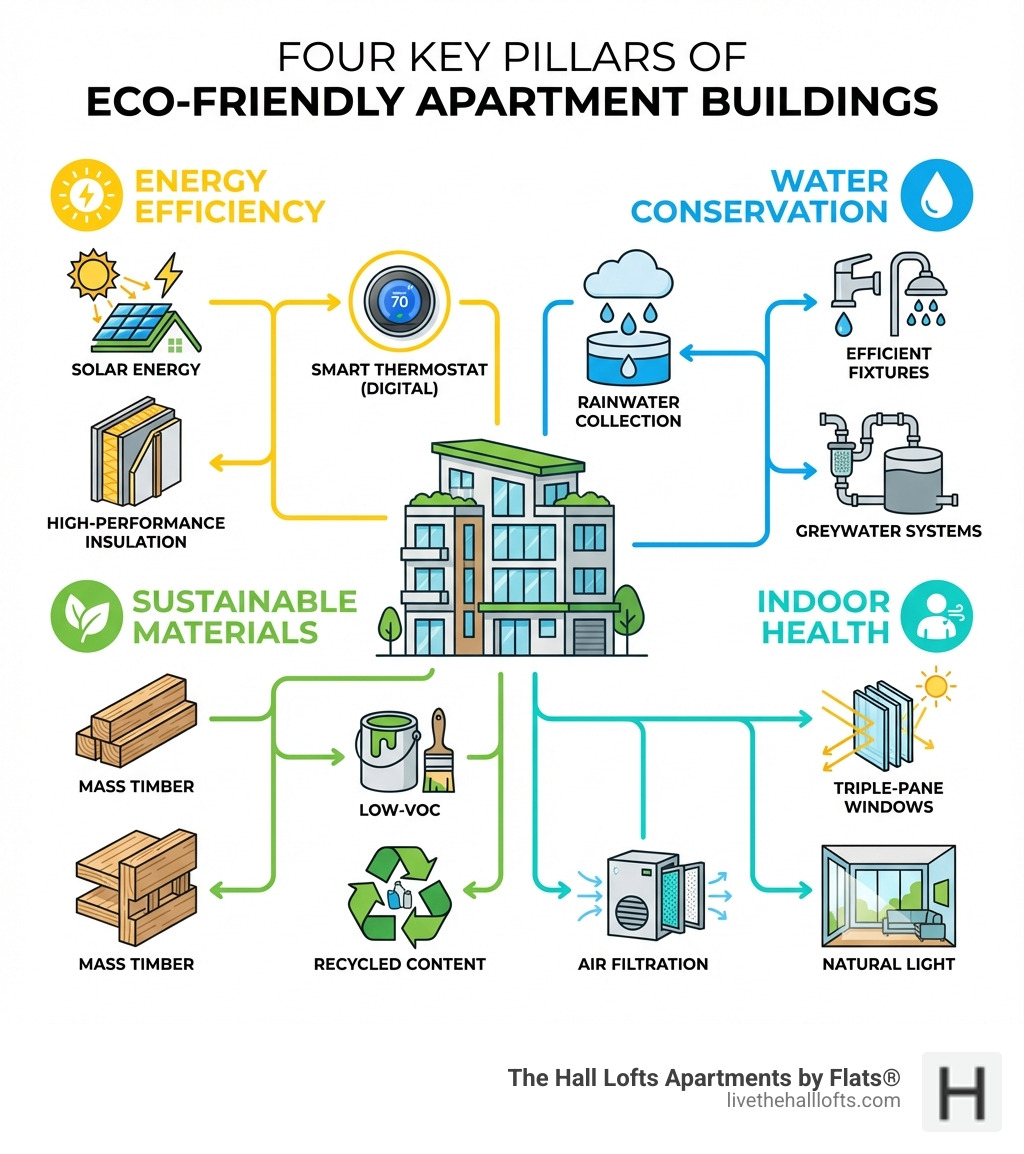
Key features that define green apartment buildings:
- Energy Systems - Solar power, high-efficiency HVAC, smart thermostats, and superior insulation that can reduce energy use by 80-90%
- Water Conservation - Rainwater collection, efficient fixtures, drought-tolerant landscaping, and greywater systems
- Building Materials - Mass timber construction, low-VOC paints, recycled content, and sustainably sourced materials
- Indoor Health - Triple-pane windows, energy recovery ventilation, non-toxic finishes, and superior air quality
- Third-Party Verification - LEED certification, Passive House standard, and local green building requirements
The numbers tell a compelling story. Buildings generate nearly 40% of annual global greenhouse gas emissions. Yet innovative apartment communities are proving that sustainable design doesn't mean sacrifice. The largest Passive House building in the world uses 80-90% less energy than conventional buildings while maintaining superior comfort. Some Canadian green apartments demonstrate that eco-friendly living can be achieved at various price points.
Modern green buildings address more than environmental concerns. Residents experience tangible daily benefits: lower utility bills, consistent temperatures year-round, quieter living spaces thanks to superior insulation, and cleaner indoor air from advanced ventilation systems.
In Minneapolis, the evolution toward sustainable multifamily housing reflects both growing environmental awareness and practical benefits. From historic building adaptations to new construction featuring mass timber and solar arrays, the local market demonstrates how eco-friendly design improves urban living.
This shift isn't just about individual buildings. It represents a fundamental rethinking of how apartment communities can support both resident wellness and planetary health through thoughtful design, innovative materials, and proven building science.
What Defines a Truly Green Apartment Building?
A truly green apartment building is more than just a structure with a few solar panels on the roof; it is a holistic ecosystem designed to minimize environmental impact while maximizing resident well-being. These eco friendly apartment buildings integrate sustainable practices from conception through construction and operation. They tackle the significant challenge posed by the building sector, which is responsible for nearly 40% of annual global greenhouse gas emissions, by focusing on key areas: the building's outer shell, its energy and water systems, the materials used, and the quality of the indoor environment.
The design of a green apartment building starts with a robust building envelope – the physical separator between the interior and exterior environments. This includes the walls, roof, foundation, windows, and doors. A high-performance envelope is crucial for maintaining consistent indoor temperatures and preventing energy loss. Beyond the envelope, advanced systems for energy efficiency and water conservation are paramount. This involves using renewable energy, optimizing heating and cooling, and significantly reducing water consumption. The selection of sustainable materials, from structural components to interior finishes, further reduces the building's carbon footprint and promotes healthier indoor air.
Key technologies in eco friendly apartment buildings
The integration of cutting-edge technologies is fundamental to achieving sustainability in modern apartment complexes. These innovations transform a standard building into an eco friendly apartment building.
- Solar Power: Rooftop photovoltaic (PV) systems are a cornerstone, converting sunlight directly into electricity. Some communities use large-scale PV systems, providing up to 100% of the electricity for both common areas and individual apartments. This dramatically reduces reliance on fossil fuels and can lead to significant energy bill reductions.
- Water Reclamation: Far from simply saving water, advanced systems actively reclaim and reuse it. Water used by residents and rainwater can be captured, treated, and repurposed for landscape irrigation or other non-potable uses. This "full-circle living" approach significantly conserves precious water resources.
- High-Performance Insulation: Superior insulation is a hallmark of energy-efficient design. This often includes thick, insulated walls and roofs that prevent heat transfer, keeping interiors warm in winter and cool in summer. Coupled with airtight construction, this reduces the need for extensive heating and cooling, leading to substantial energy savings.
- Low-VOC Materials: Volatile Organic Compounds (VOCs) found in many conventional paints, adhesives, and finishes can off-gas harmful chemicals into the air. Eco friendly apartment buildings prioritize low-VOC or zero-VOC alternatives, contributing to superior indoor air quality and resident health.
- Smart Thermostats: Devices like Nest smart thermostats allow residents to remotely control and optimize their unit's temperature settings. These intelligent systems learn habits and adjust heating and cooling automatically, leading to greater efficiency and personalized comfort.
- Energy Star Appliances: Equipping units with Energy Star certified appliances (refrigerators, dishwashers, washing machines, etc.) ensures that daily tasks are performed with minimal energy and water consumption.
- High-Efficiency Windows: Triple-pane windows with low-emissivity (Low-E) coatings are designed to minimize heat transfer while maximizing natural light. These windows are not only energy-efficient but also contribute to a quieter indoor environment by reducing outside noise. For apartments with generous dimensions, such as those with Apartments with High Ceilings, efficient window design is particularly important for temperature regulation and energy conservation.
The importance of third-party certifications
Certifications play a crucial role in verifying the environmental performance and sustainability claims of eco friendly apartment buildings. They provide a standardized framework for design, construction, and operation, offering assurance to residents and developers alike.
- LEED Certification: Leadership in Energy and Environmental Design (LEED) is a globally recognized green building certification program. It provides a comprehensive framework for healthy, highly efficient, and cost-saving green buildings. LEED certification is awarded based on a point system across various categories, including sustainable sites, water efficiency, energy and atmosphere, materials and resources, and indoor environmental quality. Achieving LEED Platinum, the highest level, signifies exceptional commitment to sustainability.
- Passive House Standard: The Passive House standard is a rigorous, performance-based certification focused on extreme energy efficiency, particularly for heating and cooling. Passive House projects are known for reducing energy consumption by up to 90% for heating and cooling compared to conventional buildings. This standard emphasizes an airtight building envelope, high-performance insulation, thermal bridge-free design, and high-quality windows. The result is a building that maintains a comfortable indoor temperature year-round with minimal energy input. For more details on this standard, exploring More on Passive House projects can provide valuable insights.
These certifications are not merely badges; they represent a commitment to measurable environmental performance and a higher standard of living. They ensure that claims of "eco-friendliness" are backed by robust scientific principles and independent verification, leading to tangible benefits in energy savings, comfort, and health for residents.
The Blueprint for Sustainability: Innovative Construction and Design
The construction and design phases are where the vision for an eco friendly apartment building truly takes shape. This involves moving beyond conventional building practices to accept innovative methodologies and materials that prioritize energy efficiency, carbon reduction, and long-term sustainability.
Passive House principles, while a certification, also serve as a foundational blueprint for design. This approach centers on creating an incredibly efficient building shell. Key elements include:
- Airtight Construction: Meticulous sealing of the building envelope prevents uncontrolled air leakage, which is a major source of energy loss. This ensures that conditioned air stays inside and unconditioned air stays out, making heating and cooling much more efficient.
- Thermal Bridge-Free Design: Thermal bridges are areas where insulation is interrupted, allowing heat to escape or enter. Designing to eliminate these bridges ensures continuous insulation around the entire building, preventing cold spots and further enhancing energy performance.
- High-Performance Insulation: Beyond standard insulation, Passive House buildings often feature significantly thicker and higher-R-value insulation in walls, roofs, and foundations. This creates a highly effective thermal barrier.
- Triple-Pane Windows: These specialized windows feature three panes of glass with inert gas (like argon or krypton) between them, providing exceptional insulation and minimizing heat transfer. They also contribute significantly to soundproofing.
- Energy Recovery Ventilation (ERV): In a tightly sealed building, controlled ventilation is essential for fresh air. ERV systems continuously bring in fresh outdoor air while recovering heat (or coolness) from the outgoing stale air, ensuring excellent indoor air quality without sacrificing energy efficiency.
Another groundbreaking innovation in sustainable construction is mass timber. This includes engineered wood products like Cross-Laminated Timber (CLT) and Glued Laminated Timber (Glulam).
- Carbon Storage: Mass timber offers a unique advantage: it stores carbon. As trees grow, they absorb carbon dioxide from the atmosphere. When used in buildings, this carbon remains stored in the wood, effectively sequestering it for the lifespan of the structure. This contrasts sharply with concrete and steel, which are energy-intensive to produce and release significant carbon emissions.
- Prefabricated Panels: Mass timber components can be prefabricated off-site, leading to faster construction times, reduced waste, and quieter construction sites. This efficiency benefits both developers and surrounding communities.

Integrating nature: Biophilic and landscape design
Beyond the structural elements, eco friendly apartment buildings increasingly incorporate biophilic design and green spaces to improve resident well-being and foster a connection with nature. Biophilic design is an architectural approach that seeks to connect building occupants more closely to nature.
- Green Roofs: These living roofs are covered with vegetation, offering numerous benefits. They insulate the building, reduce stormwater runoff, filter pollutants, and provide habitats for local wildlife. They can also create beautiful, usable outdoor spaces for residents.
- Rooftop Terraces and Community Gardens: Changing rooftops into communal areas with lush plantings, seating, and even gardening plots offers residents valuable outdoor space for relaxation, socializing, and growing their own food.
- Courtyards: Inner courtyards can serve as tranquil oases, providing natural light and ventilation to interior units, managing stormwater, and offering shared green spaces for residents.
- Living Walls: Vertical gardens on building facades or interior walls bring greenery directly into the living environment, improving air quality, enhancing aesthetics, and creating a sense of calm.
These natural integrations not only contribute to the building's ecological footprint but also profoundly impact resident well-being, reducing stress and promoting a healthier lifestyle. The thoughtful incorporation of green spaces and natural elements is a testament to innovative design, as exemplified by firms that focus on integrated, sustainable solutions. To learn more about how architects approach these innovative designs, visiting More about innovative design from architectsAlliance can offer further perspective.
The Resident Experience in Eco Friendly Apartment Buildings
Living in an eco friendly apartment building offers a distinctly liftd experience that goes far beyond simply "going green." These buildings are carefully designed to provide a level of comfort, health, and tranquility that often surpasses conventional residences.
One of the most immediate benefits residents notice is the consistent indoor temperatures. Thanks to superior insulation, airtight construction, and high-performance windows, these buildings maintain a consistent and comfortable temperature year-round. This means fewer drafts, no sudden temperature swings, and a cozy environment regardless of the weather outside.
Furthermore, these buildings boast superior indoor air quality. Advanced ventilation systems, often incorporating Energy Recovery Ventilators (ERVs), continuously bring in fresh, filtered outdoor air while exhausting stale indoor air. This process removes pollutants, allergens, and odors, ensuring a healthier breathing environment. The quiet operation of these systems, combined with the insulating properties of the building envelope, also contributes to significantly reduced noise pollution. For instance, buildings designed with 16-inch thick walls provide exceptional sound dampening, creating a quieter, more relaxing living space.
The thoughtful integration of green spaces, such as rooftop terraces or courtyards, also offers residents a direct connection to nature. This access to greenery and natural light is known to improve mood and overall well-being. The cumulative effect of these features is a living environment that is more comfortable, healthier, and more serene. For those seeking such improved living environments, exploring options for Urban Living Spaces Minneapolis can reveal similar thoughtfully designed communities.
Health and wellness benefits
The emphasis on creating a healthy indoor environment is a cornerstone of eco friendly apartment buildings. This focus translates into tangible health and wellness benefits for residents:
- Low-VOC Paints and Finishes: By using paints, adhesives, and sealants with low or zero Volatile Organic Compounds, the release of harmful chemicals into the air is drastically reduced. This minimizes respiratory issues, headaches, and other health concerns associated with indoor air pollution.
- Non-Toxic Materials: From flooring to cabinetry, materials are selected for their non-toxic properties, ensuring that residents are not exposed to hazardous substances in their daily lives.
- Abundant Natural Light: Large, well-placed windows allow ample natural light to flood living spaces, reducing the need for artificial lighting, enhancing mood, and supporting natural circadian rhythms.
- Reduced Allergens and Pollutants: The combination of filtered fresh air, reduced moisture (which can lead to mold), and non-toxic materials significantly lowers the presence of indoor allergens and pollutants, benefiting those with allergies or asthma.
- Mental Well-being: Access to green spaces, natural light, and a tranquil indoor environment contributes to reduced stress, improved concentration, and an overall improved sense of mental well-being.
How smart features improve daily life
Modern eco friendly apartment buildings often integrate smart technologies that not only optimize energy use but also simplify and improve daily life for residents.
- Smart Thermostats: These intelligent devices learn resident preferences and automatically adjust heating and cooling, ensuring optimal comfort and efficiency without constant manual input. Many can be controlled remotely via smartphone, allowing residents to set the perfect temperature before arriving home.
- Energy Monitoring Displays: Some buildings provide in-home displays that allow residents to track their real-time energy usage. This transparency empowers individuals to understand their consumption patterns and make informed choices to further reduce their environmental footprint.
- Automated Shades: Motorized window shades can be programmed to open and close based on the time of day, sunlight intensity, or even indoor temperature. This helps manage solar heat gain, reduce glare, and improve privacy, all while contributing to energy efficiency.
- Integrated Building Controls: Beyond individual units, smart systems can manage lighting in common areas, optimize HVAC systems for the entire building, and monitor water usage, ensuring the entire complex operates at peak efficiency.
These smart features make sustainable living effortless and convenient, seamlessly integrating eco-conscious choices into the fabric of modern apartment life. Combined with essential amenities like In Unit Washer and Dryer, these buildings offer a truly contemporary and responsible living experience.
Spotlight on Innovation: Leading Examples
The landscape of eco friendly apartment buildings is constantly evolving, with new projects pushing the boundaries of sustainable design and technology. These innovative structures serve as inspiring examples of what is possible when environmental stewardship meets modern urban living.

To illustrate the diverse approaches to sustainability, here is a comparison of features found in various cutting-edge apartment buildings:
| Feature/Standard | Passive House Buildings | Mass Timber Buildings | Solar-Powered Design |
|---|---|---|---|
| Primary Focus | Extreme energy efficiency (heating/cooling) | Reduced embodied carbon, faster construction | On-site renewable energy generation |
| Key Technologies | Airtight envelope, high-performance insulation, triple-pane windows, ERV | Cross-Laminated Timber (CLT), Glued Laminated Timber (Glulam) | Photovoltaic (PV) panels, battery storage, smart grids |
| Energy Reduction | Up to 90% for heating and cooling | Significant reduction due to insulation properties of wood, often combined with other tech | Can achieve net-zero or net-positive energy |
| Carbon Impact | Very low operational carbon | Carbon sequestration (stores carbon in wood), lower embodied carbon | Low operational carbon |
| Resident Benefits | Consistent temps, superior air quality, quiet, lower utility bills | Aesthetic appeal, potentially quieter construction, positive indoor environment | Significantly reduced/eliminated electricity bills, energy independence |
| Examples (General) | Second + Delaware (largest Passive House building in the world), Madrone Passive House | Grain Lofts, Halsa (Canada) | Solterra, Aquatera, ECO PHX |
Landmark projects in sustainable multifamily housing
Across North America, several projects stand out for their pioneering efforts in sustainable multifamily housing:
- Large-Scale Passive House Buildings: Buildings designed to the Passive House standard demonstrate remarkable energy efficiency. For instance, the largest Passive House building in the world, a notable apartment complex, uses an astonishing 80-90% less energy than conventional buildings. This is achieved through a carefully designed, airtight building envelope, superior insulation, and high-performance windows, creating an incredibly consistent and comfortable indoor environment. These buildings are a testament to the power of passive design in minimizing energy consumption.
- Net-Zero Living and Solar Power Integration: Some communities are pushing the envelope further by aiming for net-zero energy consumption. This means the building generates as much energy as it consumes over a year. Projects like Solterra and Aquatera in the US feature extensive photovoltaic systems, with hundreds of solar panels capable of providing up to 100% of the electricity for the entire community, including individual apartments. Residents in these buildings benefit from significantly reduced or even eliminated electricity bills, alongside a profound sense of environmental contribution.
- Mass Timber Construction for Carbon Storage: Mass timber is gaining traction as a sustainable alternative to steel and concrete. Buildings constructed with engineered wood products not only have a lower embodied carbon footprint (the carbon emitted during material production) but also actively store carbon within their structure. This makes them a powerful tool in combating climate change. Projects in Canada, for example, are utilizing mass timber for apartment buildings, highlighting its potential for both environmental benefits and quicker construction times due to prefabrication.
Exploring eco friendly apartment buildings in Minneapolis
Minneapolis, with its commitment to sustainability and innovation, is an ideal setting for the growth of eco friendly apartment buildings. While specific examples from the provided research focus on other regions, the principles and technologies discussed are directly applicable and increasingly adopted in urban centers like Minneapolis.
Local developers and architects are recognizing the demand for sustainable living, integrating features such as high-performance insulation, efficient HVAC systems, and thoughtful use of materials into new constructions and renovations. The city's climate, with its cold winters and warm summers, makes energy efficiency particularly valuable, driving interest in standards like Passive House that drastically reduce heating and cooling loads.
The North Loop neighborhood, known for its blend of historic industrial architecture and modern urban development, offers unique opportunities for sustainable adaptation. Historic warehouse buildings, like those that inspire The Hall Lofts, can undergo deep energy retrofits, changing them into modern, energy-efficient living spaces while preserving their unique character. This approach not only reduces waste by reusing existing structures but also brings sustainable features to highly desirable urban locations. Whether through new, purpose-built green buildings or the thoughtful renovation of existing properties, Minneapolis is embracing a future where sustainable living is not just an ideal, but a tangible reality for its residents. For those interested in the vibrant living options available in this area, exploring North Loop Apartments can provide a glimpse into the local housing landscape.
The Driving Forces Behind Sustainable Multifamily Housing
The push for eco friendly apartment buildings is not a fleeting trend but a fundamental shift driven by a confluence of factors, from evolving regulations to growing market demand and technological advancements.
- Evolving Building Codes and Green Building Standards: Governments at all levels are increasingly recognizing the critical role buildings play in climate change. This awareness is leading to more aggressive building codes that mandate higher energy efficiency standards for new constructions and major renovations. For example, some regions are implementing codes that require most new buildings to be nearly net-zero in terms of energy consumption. Green building standards, like LEED and Passive House, provide pathways to exceed these minimum requirements, offering frameworks for developers to achieve truly high-performance buildings.
- Government Incentives: To accelerate the adoption of sustainable practices, governments often provide a range of incentives. These can include grants, tax credits, low-interest loans, or density bonuses for projects that meet certain green building criteria. Such financial support can help offset the initial investment in sustainable technologies, making green development more attractive and economically viable for developers. In Canada, for instance, government grants and subsidies have been crucial in enabling the development of deeply affordable, green social housing projects, demonstrating that sustainability and affordability can go hand-in-hand.
- Private Sector Investment: A growing number of private developers and investors are recognizing the long-term value of sustainable buildings. They understand that eco friendly apartment buildings can command higher rents, have lower operating costs, and appeal to a broader tenant base that prioritizes health and environmental responsibility. The success of pioneering projects is also acting as a catalyst, encouraging more mainstream developers to integrate high-performance building practices.
- Role of Architects and Developers: Visionary architects and developers are at the forefront of this movement. They are constantly innovating, experimenting with new materials like mass timber, and integrating advanced energy systems. Their proficiency in building science and sustainable design is essential for translating ambitious environmental goals into functional, beautiful, and efficient structures.
- Challenges in Scaling: Despite the growing momentum, scaling up the construction of sustainable apartment buildings faces challenges. These can include the initial higher cost of some green materials or technologies, a shortage of skilled labor trained in green building practices, and overcoming inertia in traditional construction methods.
- Opportunities for Growth: However, the opportunities for growth are immense. As green building technologies become more mainstream, their costs are decreasing. Education and training programs are addressing the labor gap. Furthermore, the imperative to address both the climate crisis and the housing crisis simultaneously presents a unique opportunity for sustainable multifamily housing to provide solutions on multiple fronts, creating healthier, more affordable, and environmentally responsible communities.
Conclusion
The journey into eco friendly apartment buildings reveals a future where living spaces are not only comfortable and stylish but also deeply connected to health, wellness, and environmental stewardship. These buildings are defined by their commitment to reducing energy consumption, conserving water, utilizing sustainable materials, and fostering superior indoor air quality, all often verified by rigorous third-party certifications like LEED and Passive House.
The benefits for residents are clear: a home with consistent indoor temperatures, cleaner and healthier air, reduced noise pollution, and often significantly lower utility bills. Beyond individual comfort, these buildings contribute to a larger mission, actively addressing the climate crisis by drastically cutting greenhouse gas emissions from the built environment.
In vibrant urban centers like Minneapolis, the adoption of sustainable practices in multifamily housing is gaining momentum. From new constructions integrating solar power and mass timber to the thoughtful renovation of historic properties, the city is embracing modern sustainable living. The Hall Lofts, with its blend of historic warehouse charm and contemporary design, exemplifies how existing structures can be adapted to offer modern urban living, setting a precedent for responsible development in the city.
As the demand for healthier, more efficient, and environmentally conscious living continues to grow, eco friendly apartment buildings are no longer a niche concept but a cornerstone of urban development. They represent a smart choice for residents seeking a higher quality of life and a positive impact on the planet. To find more about the evolving landscape of urban residences and find a space that aligns with modern living standards, Explore new apartments in Minneapolis.