What Is Smart Apartment Technology — And Why Does It Matter?
Smart apartment technology refers to a connected system of devices, networks, and management tools that automate and streamline daily life inside a residential unit and across an entire multifamily building.
Here is a quick overview of what it includes and why people seek it out:
| Category | What It Does |
|---|---|
| Smart Access | Keyless entry, digital locks, remote visitor management |
| Climate Control | Learning thermostats, geofencing, automated schedules |
| Smart Lighting | Motion-activated, voice-controlled, and app-scheduled lighting |
| Security | Cameras, video intercoms, real-time alerts, encrypted data |
| Energy Management | Smart plugs, vacancy detection, automated shutoffs |
| Building Management | Unified dashboards for property teams and residents |
Remember watching The Jetsons as a kid and wondering if homes would ever actually work that way? In 2026, they do — and the technology is no longer reserved for custom-built homes or tech enthusiasts.
Modern renters increasingly prefer smart home features over traditional amenities like pools or spas. That shift is reshaping what multifamily buildings offer and what residents expect.
A smart apartment is not just a collection of gadgets. It is an integrated ecosystem — devices, connectivity, and management software working together. For residents, that means more convenience, better security, and lower energy use. For property teams, it means fewer maintenance emergencies and smoother operations.
This guide breaks down everything: the core technology, the key benefits, what to look for as a renter, and where the industry is heading.
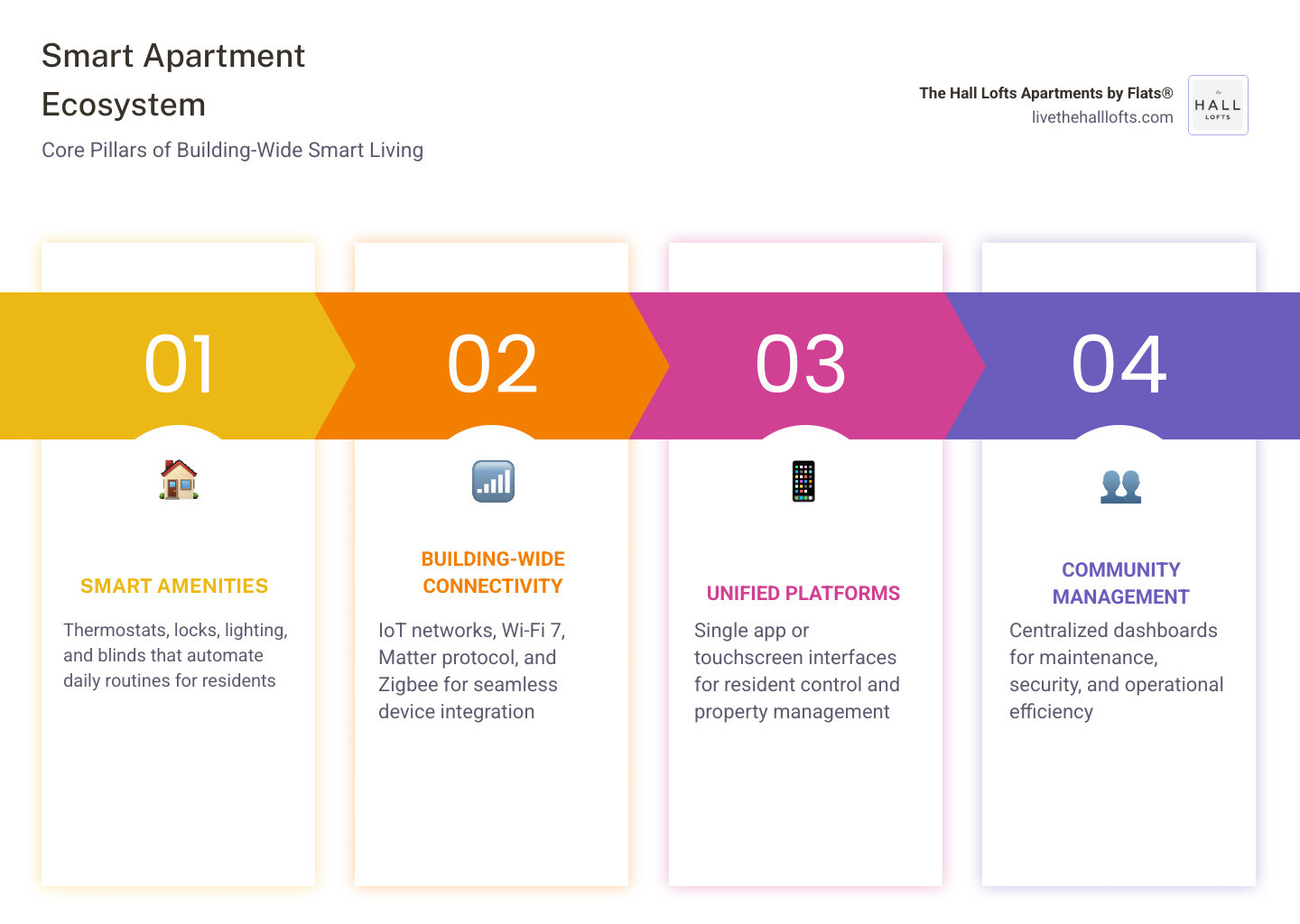
Defining the Modern Smart Apartment Ecosystem
The modern smart apartment technology landscape has evolved significantly by 2026. It is no longer defined by a single smart speaker sitting on a kitchen counter. Instead, it is a comprehensive building-wide infrastructure that treats connectivity as a fundamental utility, much like water or electricity. This ecosystem relies on three core pillars: smart amenities, building-wide connectivity, and integrated community management.
At the heart of this system is the IoT (Internet of Things) network. In a high-quality multifamily environment, this network connects individual unit devices—such as thermostats and locks—to a centralized property management system. This allows for a unified platform where residents can control their entire living environment through a single interface, often an in-wall touchscreen or a mobile application.
For property owners, these systems provide a dashboard that offers real-time data on building health. This includes monitoring for energy waste in vacant units or detecting early signs of equipment failure. By integrating Smart Home Control & Home Automation Technologies | Brilliant NextGen, buildings can offer a seamless experience where lighting, climate, and security are managed through one cohesive "brain."
Distinguishing Smart Apartments from Traditional Smart Homes
While the terms are often used interchangeably, a smart apartment differs from a traditional smart home in several critical ways:
- Infrastructure vs. Gadgets: A traditional smart home is often a DIY project where a homeowner buys various devices and hopes they work together. A smart apartment features integrated infrastructure built into the walls and the building's backbone.
- Management Dashboards: Smart apartments include a management layer for property teams. This allows for the automation of "unit turns"—the process of preparing an apartment for a new resident.
- Resident Turnover Automation: In a smart apartment, resident access can be automatically revoked upon move-out and granted to a new tenant upon move-in. This eliminates the need for physical rekeying, which saves significant time and resources.
- Scalability: Systems in multifamily buildings must handle hundreds of users and thousands of devices simultaneously without interference, requiring professional-grade hardware rather than consumer-level routers.
The Role of Connectivity in Smart Apartment Technology
Connectivity is the invisible thread that holds a smart apartment together. By 2026, Wi-Fi 7 has become the standard for high-density residential buildings in Minneapolis, providing the bandwidth necessary for hundreds of connected devices to operate without lag.
A significant shift in the industry is the move toward hubless systems. Older technology required a separate "hub" to bridge devices like smart locks to the internet. Modern systems often connect directly to the building’s IoT network or use the Matter protocol, which ensures that devices from different manufacturers can communicate effortlessly.
Furthermore, the use of 5GHz and 6GHz bands is essential in dense urban environments like the North Loop to avoid the signal interference common in older 2.4GHz networks. This robust connectivity ensures that a resident's "one-click bedtime" routine—which might dim the lights, lock the door, and lower the thermostat—executes instantly every time. For those looking to dive deeper into how these systems enhance daily life, there is More info about smart living available.

Essential Smart Apartment Technology for Residents
The primary goal of smart apartment technology is to enhance the resident experience. This is achieved through a suite of devices that prioritize convenience, security, and energy efficiency.
Key devices found in modern smart apartments include:
- Smart Locks: These allow for keyless entry via smartphone, Apple Watch, or unique PIN codes. They also enable residents to grant temporary access to guests or service providers, such as dog walkers.
- Smart Thermostats: Learning thermostats, like those from Nest or Ecobee, create customized profiles based on resident preferences and can automatically adjust to save energy when no one is home.
- Smart Lighting: From smart bulbs to integrated dimmer switches, lighting can be scheduled to wake a resident up gradually or create the "illusion of presence" for security while they are away.
- Voice Assistants: Advanced AI-driven assistants like Alexa Plus or Gemini are often integrated into the apartment's control panels, allowing for hands-free control of the entire unit.
A comprehensive look at these features can be found at Smart Apartment Devices | Brilliant NextGen, which highlights how in-wall touchscreens can replace cluttered countertops by housing all these controls in one place.
Renter-Friendly Devices and Non-Permanent Installations
For those living in apartments where permanent modifications aren't an option, the market for "renter-friendly" tech has exploded. These devices offer the benefits of a smart home without risking a security deposit.
- Plug-and-Play Gadgets: Smart plugs are perhaps the most versatile tool for renters. They can turn a "dumb" lamp or a coffee maker into a smart device that can be controlled via an app or voice command.
- Battery-Powered Security: Video doorbells and indoor cameras now come in battery-powered versions that require no wiring. These can often be mounted using heavy-duty, double-sided tape or brackets that clip onto the door.
- Portable Smart Lighting: Smart LED strips and bulbs can be swapped into existing fixtures and taken with the resident when they move.
- Smart Blinds: Modern retrofits allow residents to add motorization to existing window treatments, which can then be programmed to open and close based on the time of day to regulate indoor temperatures.
Integrated Climate and Lighting Control
The integration of climate and lighting is where residents see the most immediate impact on their daily routines. Geofencing technology uses the location of a resident's smartphone to trigger "home" or "away" modes. For example, as a resident leaves for work, the thermostat may adjust to an energy-saving temperature and all lights can be programmed to turn off automatically.
Motion sensors also play a vital role. In bathrooms or hallways, lights can be set to turn on at a low brightness during the night to guide the way without being jarring. This level of automation is not just about luxury; it is about creating a living space that anticipates needs. Detailed insights on these systems are available at Smart Climate Control.
Security and Asset Protection in Smart Apartment Technology
Security is a top priority for both residents and property managers. Smart apartment technology provides a multi-layered approach to safety that traditional systems cannot match.
| Feature | Traditional Security | Smart Apartment Security |
|---|---|---|
| Access | Physical keys (easily copied) | Digital keys/Biometrics (encrypted) |
| Monitoring | Local alarms only | Real-time smartphone alerts |
| Visibility | Peepholes | 2K HD Video doorbells with two-way audio |
| Data | None | Detailed activity logs of all entries |
| Maintenance | Reactive (find the leak after damage) | Proactive (sensors detect moisture instantly) |
Advanced Access Management and Video Entry
Keyless entry has become a standard expectation. Modern smart locks can achieve fingerprint recognition in as little as 0.3 seconds, providing a speed and convenience that physical keys lack. Beyond the front door, video entry systems allow residents to see and speak with visitors at the building's main entrance from their smartphones.
This technology also addresses the growing concern of package protection. Secure package rooms or lockers integrated with the building’s access system ensure that deliveries are kept safe until the resident can retrieve them, with notifications sent the moment a parcel arrives.
Proactive Maintenance and Leak Detection
One of the most significant advantages of smart apartment technology is asset protection. Water damage is a leading cause of loss in multifamily buildings. By 2026, smart leak detectors placed under sinks, behind toilets, and near water heaters have become essential.
These sensors can detect moisture or unusual humidity levels and send an immediate alert to both the resident and the property management team. In some advanced implementations, the system can even trigger an automated water shutoff valve to prevent a minor leak from becoming a catastrophic flood. Statistics indicate that buildings using these proactive platforms can see a reduction in water damage costs by over 75%.
Future Trends in Multifamily Living
As we look toward the future of multifamily living, several trends are driving the continued adoption of smart technology.
- Artificial Intelligence: Generative AI assistants are becoming more deeply integrated into the home. These assistants don't just follow commands; they offer suggestions, such as reminding a resident to start their laundry during off-peak energy hours.
- Time Arbitrage: Technology is increasingly viewed as a tool to reclaim time. Smart apartments enable "on-demand" services, allowing residents to securely grant access to cleaners, grocery delivery services, or dog walkers while they are at work.
- ESG and Sustainability: Building owners are using smart tech to meet Environmental, Social, and Governance (ESG) goals. Intelligent efficiency technology can save the commercial real estate sector over $50 billion by optimizing energy use building-wide.
- Warehouse Retrofits: In cities like Minneapolis, there is a strong trend toward retrofitting historical warehouse buildings with modern technology. This allows for the preservation of historical charm while providing the high-tech amenities that modern residents demand.

Frequently Asked Questions about Smart Apartment Technology
What makes an apartment "smart" compared to a standard unit?
A smart apartment features an integrated ecosystem where devices like locks, lights, and thermostats are connected to a building-wide network. Unlike a standard unit where a resident might bring their own individual gadgets, a smart apartment has the infrastructure built-in, allowing for unified control and building-wide benefits like automated maintenance alerts.
Are smart apartment devices secure from hacking?
Security is a primary focus for reputable smart technology providers. Modern systems use end-to-end encryption, similar to what is used in online banking. Additionally, property-wide IoT networks are typically separate from the resident's personal Wi-Fi, providing an extra layer of cybersecurity. Residents are encouraged to use two-factor authentication on all management apps to further protect their data.
Can residents add their own devices to a building's smart system?
Yes, most modern smart apartment platforms are designed to be "open" or "hubless." This means residents can often integrate their own personal devices, such as smart speakers, additional smart bulbs, or connected fitness equipment, into the existing building system. The use of the Matter protocol has made this cross-brand compatibility easier than ever in 2026.
Conclusion
The evolution of smart apartment technology has transformed the way people live in urban environments. By blending sophisticated software with hardware that prioritizes security and efficiency, multifamily buildings are now more than just places to sleep—they are responsive environments that save time and energy.
In the North Loop of Minneapolis, this technology finds a unique home. The area is known for its stunning warehouse conversions that pair historical industrial elements with the height of modern urban luxury. Residents in these spaces enjoy the best of both worlds: the character of original brick and timber alongside the convenience of in-unit laundry, pet-friendly policies for up to two pets, and fully integrated smart home systems.
As the demand for connected living continues to grow, the integration of these technologies will remain a defining feature of the Minneapolis real estate market. To experience these features and see how historical charm meets contemporary design, residents can Explore modern urban amenities and discover the future of Minneapolis living.