What an In-Unit Washer Dryer Really Means for Urban Renters
An in-unit washer dryer is exactly what it sounds like: a washing machine and dryer located inside the apartment itself — not down the hall, not in a shared basement room, and not at a laundromat two blocks away.
Here's a quick breakdown of what that means in practice:
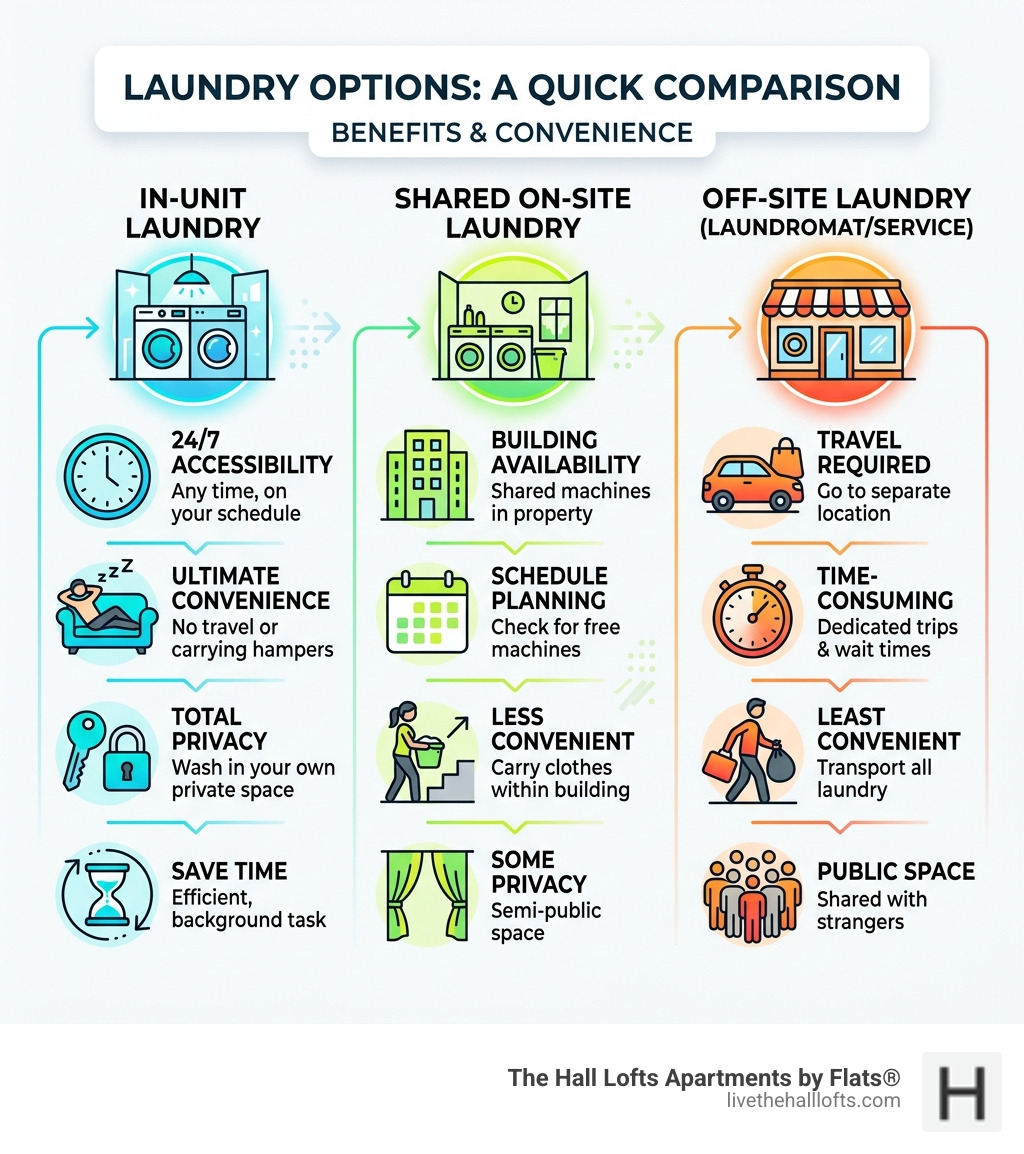
- In-unit laundry = machines inside your private apartment, available 24/7
- Onsite laundry = shared machines somewhere else in the building
- Off-site laundry = laundromats or wash-and-fold services outside the property
Why does this distinction matter? Because convenience, privacy, and time savings are very different across these three options.
Laundromat visits average $3–$4 per load — and that's before factoring in travel time. Shared building laundry rooms can run $1.50–$4.00 per load, with no guarantee a machine is free when needed. In-unit laundry eliminates both of those friction points entirely.
For urban residents juggling busy schedules, the appeal is straightforward: do laundry on your own time, in your own space, without carrying a hamper anywhere.
That demand is real and growing. In Denver alone, over 14,000 rental apartments list an in-unit washer and dryer as an available amenity — making it one of the most-searched filters on major rental platforms.
But there's a catch. Not every apartment is set up for it. Space constraints, venting limitations, and hookup availability all shape what's possible — and what to look for.
The Functional Benefits of an In-Unit Washer Dryer
The presence of an in-unit washer and dryer transforms the weekly chore of laundry from a logistical mission into a background task. One of the most significant advantages is resident autonomy. Instead of checking a mobile app or walking down three flights of stairs to see if a communal machine is available, the equipment is ready whenever the schedule allows. This is particularly beneficial for those who prefer to do laundry in small, frequent bursts rather than dedicating an entire Sunday to multiple loads.
Privacy and security also rank high on the list of benefits. Using a shared facility often means handling delicates in public or worrying about clothing being moved or removed by others if a timer is missed. With an in-unit washer and dryer, garments stay within the private confines of the home. There is no risk of a favorite shirt going missing or the awkwardness of a neighbor finding a stray sock.
Furthermore, an apartment with washer and dryer in unit allows for better time management. Modern residents can start a load before a morning commute or right before bed without worrying about blocking access for others. This level of convenience is a primary reason why in-unit facilities are consistently listed as a top-tier amenity in urban markets.
Compact Laundry Solutions for Limited Square Footage
In many renovated urban spaces, traditional full-sized laundry sets simply won't fit. Standard full-size washers are often 27 inches wide or more, but in-unit laundry apartments frequently utilize compact dimensions to maximize livable square footage.
Compact washers and dryers typically measure 24 inches in width. These "apartment-sized" units are designed with a closet-depth footprint, usually ranging from 24 to 26 inches deep. While they are smaller, they are surprisingly capable, offering capacities between 1.5 and 3.4 cubic feet—ideal for households of one to three people.
| Feature | Compact Units | Full-Size Units |
|---|---|---|
| Width | 24 inches | 27+ inches |
| Height (Stacked) | 66–72 inches | 75+ inches |
| Depth | 24–26 inches | 30–34 inches |
| Capacity | 1.5–3.4 cu. ft. | 4.0–5.5 cu. ft. |
All-in-One In-Unit Washer Dryer Systems
For the tightest floor plans, an all-in-one system is often the most efficient choice. These machines perform both washing and drying functions in a single drum, eliminating the need to transfer wet clothes between machines. A popular example is the 2.3 cu.ft. Compact All-In-One Washer/Dryer - WM3488HW, which fits into the same footprint as a standard dishwasher.
Many of these combo units utilize ventless condensing technology. Instead of exhausting hot, moist air through a hole in the wall, they cool the steam and turn it back into water, which is then pumped out through the drain hose. This allows for "go-anywhere" installation in closets or under kitchen counters where external venting isn't feasible. While cycle times can be longer—sometimes taking two to four hours for a full wash-and-dry cycle—the trade-off is significant space savings.
Measuring for an In-Unit Washer Dryer
Ensuring a unit fits requires more than just checking the width. When consulting a 1-bedroom apartments washer dryer guide, it is important to account for vertical clearance and door swing. Stackable units usually require 66 to 72 inches of vertical space.
Additionally, depth is critical. Even if a machine is 24 inches deep, extra space is needed behind the unit for hoses, power cords, and potentially a dryer vent. A "closet-depth" design aims to minimize this, but one should always measure the "real-world" depth required for the doors to open fully without hitting a wall or cabinetry. Proximity to a grounded electrical outlet and a water source is the final piece of the measurement puzzle.
Installation Requirements and Space Planning
The technical side of an in-unit washer dryer involves power and plumbing. Most compact and all-in-one units are designed for 120V electrical connections, which are standard three-prong outlets found in any room. However, some heavy-duty or older stackable sets may require a 240V outlet, similar to what a kitchen range uses.
Advancements in heat pump technology have revolutionized apartment laundry. Units like the PFQ83HSSWWW by GE Appliances - GE Profile™ ENERGY STAR® 4.6 cu. ft. Capacity UltraFast Combo with Ventless Inverter Heat Pump Technology Washer/Dryer use a closed-loop system to dry clothes. This is significantly more energy-efficient than traditional vented drying and removes the need for a complex exhaust system.
In spaces without dedicated laundry hookups, portable options provide flexibility. Some small washers feature a drain pump and sink adapters, allowing them to hook up to a standard kitchen or bathroom faucet for the duration of the cycle. While less permanent, these solutions offer the same privacy and convenience as built-in models.
Maintenance and Longevity of Apartment-Sized Appliances
To keep an apartment-sized laundry system running efficiently, regular maintenance is mandatory. Because these units are often in small, enclosed spaces, moisture management is key. Leaving the washer door slightly ajar after a cycle helps prevent the growth of mold and odors. Many modern units also include a "TubClean" cycle specifically designed to sanitize the drum and gaskets.
Lint management is the most critical safety task. In all-in-one or ventless units, lint traps may be located in different areas than traditional dryers. Cleaning these after every single load ensures proper airflow and prevents fire hazards. Some high-end models now feature antimicrobial gaskets to further reduce the risk of odors.
Energy efficiency is another hallmark of newer compact models. Look for Energy Star ratings and features like load sensing technology, which adjusts water levels based on the weight of the clothes. High-efficiency (HE) detergent is usually required for these machines to prevent excess sudsing, which can damage the internal sensors. Finally, vibration reduction systems are essential in apartment living to ensure the machine doesn't disturb neighbors during a high-speed spin cycle.
Frequently Asked Questions about In-Unit Laundry
What are the typical dimensions for a compact washer and dryer?
Most compact units are 24 inches wide, which is the industry standard for apartment-sized appliances. The height for individual units is usually around 33 to 36 inches, while stacked configurations reach 66 to 72 inches. Depth typically ranges from 24 to 26 inches.
Do all-in-one washer-dryer combos require external venting?
Many modern all-in-one combos are ventless. They use either condensation or heat pump technology to manage moisture, meaning they only require a standard power outlet and a drain. However, some specific models are still designed to be vented, so it is important to check the specifications before choosing a location.
Can a washer and dryer be installed in an apartment without dedicated hookups?
Yes, through portable models. These units are designed to connect to a standard sink faucet using a quick-connect adapter. They drain directly into the sink or a bathtub. However, it is vital to check lease agreements before installing any laundry equipment to ensure compliance with building policies.
Conclusion
Modern urban living in Minneapolis is about more than just a place to sleep; it is about finding a space that supports a seamless lifestyle. The blend of historical charm and contemporary design in renovated warehouse apartments offers a unique atmosphere, but it is the functional amenities like the in-unit washer dryer that truly elevate the experience.
Whether it is a sleek all-in-one unit tucked into a kitchen island or a vertical stack in a walk-in closet, having private laundry facilities is a game-changer for resident convenience. In a city where winter weather can make a trip to the laundromat a daunting task, the ability to handle chores within the warmth of a pet-friendly, modern home is invaluable. For those looking to dive deeper into the nuances of loft living, exploring a More info about warehouse apartment living can provide further insight into how these spaces are designed for the modern era.