What Is a Warehouse House Conversion?
A warehouse house conversion is the process of transforming an industrial or commercial warehouse building into a fully livable residential space. Here's a quick overview of what that involves:
- What it is: Adapting an industrial building for residential use while preserving its original character
- Key features: High ceilings, exposed brick, open floor plans, oversized windows, and original structural elements
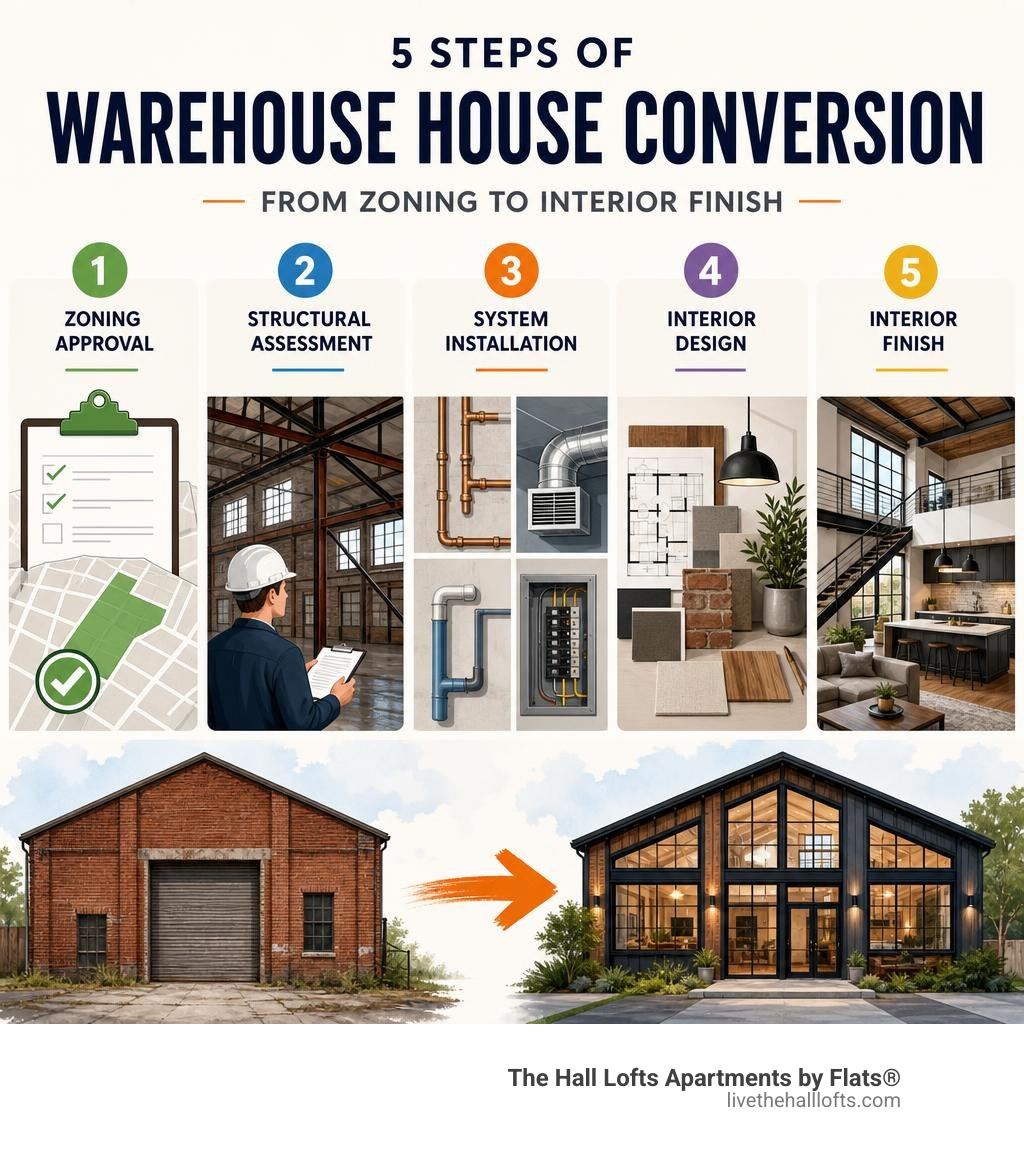
- Process steps: Zoning approval → structural assessment → system installation (plumbing, HVAC, electrical) → interior design
- Timeline: Most projects take 9 to 26 months from planning to completion
- Who it suits: Those who want spacious, character-rich living that standard apartments rarely offer
Old warehouses have something most new homes simply don't. Raw materials. Soaring ceilings. Real architectural history. That combination has made warehouse-to-home conversions one of the most sought-after property types in cities across the country.
From Brooklyn lofts to Minneapolis' historic North Loop, former industrial buildings are being reimagined as dynamic living spaces — ones that balance preserved heritage with modern comfort.
The appeal is easy to understand. These buildings were built to last, with heavy timber beams, thick brick walls, and generous floor plates. When converted thoughtfully, they offer a scale and character that new construction rarely matches.
But converting a warehouse into a home isn't simple. It touches on zoning law, structural engineering, building systems, and design — all at once. This guide breaks down everything worth knowing before stepping into that world.
The Appeal and Architecture of a Warehouse House Conversion
An industrial building possesses a distinct physical presence. The architectural integrity of these structures stems from their original purpose: housing heavy machinery, manufacturing goods, or storing large shipments. Consequently, they feature structural elements that are difficult and expensive to replicate in modern residential construction.
Thick masonry walls, massive timber support columns, and soaring ceilings are standard elements of these properties. Rather than concealing these industrial details, successful conversions celebrate them. This design philosophy forms the foundation of the Industrial Warehouse Apartments Guide, which highlights how structural honesty creates authentic living spaces.

A notable real-world example of this balance is the Dempsey Warehouse Conversion Case Study. This project demonstrated how an industrial shell could be adapted into multi-unit live-work spaces while preserving layers of local history. By keeping the original structural fabric intact, the building retains its connection to the neighborhood's working-class past while serving modern residential needs.
Key Design Features of a Warehouse House Conversion
Several defining characteristics set a warehouse house conversion apart from traditional residential design:
- Oversized Windows: Originally designed to maximize daylight for factory workers before the widespread use of electricity, these massive window openings flood spaces with natural light.
- Exposed Brick and Timber Beams: Unadorned brick walls and heavy timber framing provide texture, warmth, and visual interest that painted drywall cannot replicate.
- Concrete or Hardwood Flooring: Original industrial floors, whether distressed maple or polished concrete, tell the story of the building's previous life.
In projects like the Camperdown Warehouse Project, modern structural insertions like Cross Laminated Timber (CLT) and custom steel joinery are integrated directly into the retained historic concrete shell. This approach creates a striking dialogue between old and new materials. For those interested in exploring these aesthetics, the Warehouse Loft Style Apartments guide offers insight into how these raw textures are styled for daily living.
Spatial Layouts and Zoning in a Warehouse House Conversion
The immense volume of industrial buildings presents unique spatial opportunities. With ceiling heights frequently ranging from 15 to 30 feet, vertical space becomes a major design asset.
Mezzanine levels are frequently installed to create semi-private spaces for bedrooms, home offices, or libraries without disrupting the overall sense of openness. This technique is detailed in the resource on Turning a Warehouse into a Home, which examines how structural constraints can be navigated to establish functional living areas.
To maintain the architectural integrity of the open floor plate, designers often avoid building traditional floor-to-ceiling walls. Instead, spatial zoning is achieved through:
- Strategic Furniture Placement: Using large sectional sofas, rugs, and shelving units to define distinct zones.
- Acoustic and Visual Screens: Utilizing steel-framed glass partitions or partial-height walls to provide separation while allowing light to penetrate deep into the floor plate.
- Level Changes: Incorporating raised platforms to physically demarcate dining or sleeping areas.
These layout strategies are essential for making large, industrial volumes feel comfortable and functional, as explored in the guide to Converted Warehouse Apartments.
Converted Warehouse Real Estate Trends and Market Values
The market for industrial conversions has evolved from a niche architectural movement into a highly competitive segment of urban real estate. Buyers are drawn to the rarity of these properties, as the supply of historic industrial stock is inherently limited.
In major metropolitan real estate markets, converted industrial properties command a premium. For instance, in New York City, there are approximately 229 converted warehouse properties listed for sale, with the most expensive historic industrial listings reaching up to $17,750,000 for massive, multi-use structures. In Brooklyn, converted warehouse condominiums typically range from $1.7 million to $2.75 million for units spanning 1,287 to 2,198 square feet.
These properties often carry a higher price per square foot than traditional apartments due to their unique architectural features, volume of space, and historical significance. The physical characteristics of these spaces are further detailed in the resource on Warehouse Apartments.
| Property Feature | Converted Warehouse | Traditional Apartment |
|---|---|---|
| Average Ceiling Height | 12 to 20+ feet | 8 to 9 feet |
| Primary Materials | Exposed brick, heavy timber, concrete, steel | Drywall, engineered wood, plaster |
| Layout Flexibility | High (open-plan, mezzanine potential) | Low (fixed multi-room layouts) |
| Window Dimensions | Oversized industrial sash or arched masonry | Standard residential sizes |
| Acoustic Profile | High volume, requires soft finishes | Contained rooms, standard insulation |
Neighborhood Hotspots for Industrial Conversions
Historically, industrial conversions have concentrated in neighborhoods that served as manufacturing and shipping hubs. In New York, areas like DUMBO, Williamsburg, and Tribeca pioneered this trend.
In the Midwest, Minneapolis has established itself as a premier destination for industrial living, centered around the historic North Loop. Once a bustling center of warehousing and rail shipping during the city's milling boom, the North Loop contains one of the country's highest concentrations of preserved late-19th-century industrial architecture.
This transformation is supported by local initiatives, as highlighted in the Minneapolis Apartment Conversions News, which details how the city continues to look to its historic Warehouse District to meet the demand for unique urban housing. To learn more about the history and availability of these spaces, refer to the guide on Historic Warehouse Lofts Minneapolis.
Key Considerations: Regulations, Historical Status, and Building Systems
While the aesthetic appeal of a converted industrial space is undeniable, purchasing or executing a conversion requires a thorough understanding of regulatory and physical challenges.
- Zoning and Change-of-Use Permits: Industrial buildings are historically zoned for manufacturing or commercial activities. Converting a warehouse to residential use requires a formal change-of-use permit and municipal approval, a process that can take anywhere from 3 to 12 months.
- Historical Preservation Guidelines: Many of the most desirable warehouses are located in historic districts or listed on national registries. This status limits the modifications that can be made to the exterior facade, window designs, and structural elements.
- Building Systems Overhaul: Warehouses were not built with residential comfort in mind. Conversions require entirely new plumbing stacks, updated electrical services (often requiring three-phase power upgrades), and sophisticated HVAC systems capable of zoning large, high-ceiling spaces.
- Thermal Performance and Insulation: Uninsulated brick walls and original single-pane steel windows are highly inefficient. Modern conversions must integrate advanced insulation techniques—such as insulated metal stud systems or high-performance glass—without concealing the historic masonry, as demonstrated in the Five Oh Five Warehouse Conversion case study.
Navigating these regulatory and structural complexities is vital for anyone considering an industrial property, as discussed in the Complete Warehouse Apartment Guide.
Frequently Asked Questions About Warehouse Conversions
What are the main benefits of living in a converted warehouse?
Living in an industrial conversion offers unmatched architectural character, expansive spatial volume, and design versatility. The massive structural capacity of these buildings allows for open-plan layouts that can adapt to changing lifestyles over time. Additionally, the presence of original materials like century-old timber and weathered brick provides a sense of history and craftsmanship that is absent in modern, mass-produced housing. These advantages are explored in depth in the article on the Industrial Warehouse Apartment.
What challenges should buyers expect with industrial conversions?
The primary challenges involve climate control, acoustic management, and structural constraints. Heating and cooling a home with 18-foot ceilings requires well-designed HVAC systems to prevent temperature stratification. Additionally, hard surfaces like concrete floors and brick walls reflect sound, which can lead to echo issues unless managed with soft furnishings, rugs, and acoustic panels.
Furthermore, structural elements like load-bearing columns cannot be moved, requiring creative layout solutions. Some experimental projects, such as the Warehousehouse Project, have embraced these challenges by designing flexible, multi-use zones that accommodate both daily living and technological research within a single open structure.
How do HOA fees and historical regulations affect these properties?
Properties located within historically designated districts must comply with strict preservation guidelines. Any modifications to visible exterior elements, such as windows or entryways, must be approved by local landmark commissions.
In condominium conversions, homeowners association (HOA) fees may reflect the specialized maintenance required to preserve historic facades, repair aging masonry, or maintain unique building amenities. Prospective buyers should carefully review association bylaws and historical guidelines, as outlined in the Warehouse Apartments for Rent Guide.
Conclusion
A warehouse house conversion represents a thoughtful intersection of historic preservation and modern residential design. These homes offer a unique living experience characterized by soaring volumes, authentic industrial materials, and open, adaptable floor plans.
For those seeking this distinctive lifestyle in Minneapolis, The Hall Lofts Apartments by Flats® provides beautifully renovated warehouse apartments in the heart of the North Loop. Combining historic architectural elements with modern updates, these homes feature convenient in-unit laundry and welcoming, pet-friendly spaces with a standard two-pet limit.
To explore available floor plans and experience the character of a professionally converted industrial property, visit the portal for Converted Warehouse Apartments.