What Is the North Loop Neighborhood in Minneapolis?
The North Loop neighborhood in Minneapolis is one of the city's most dynamic urban districts — a compact, walkable area where century-old brick warehouses now hold acclaimed restaurants, creative offices, and modern loft apartments.
Quick facts about the North Loop:
| Feature | Detail |
|---|---|
| Also known as | The Warehouse District |
| Size | 0.837 square miles |
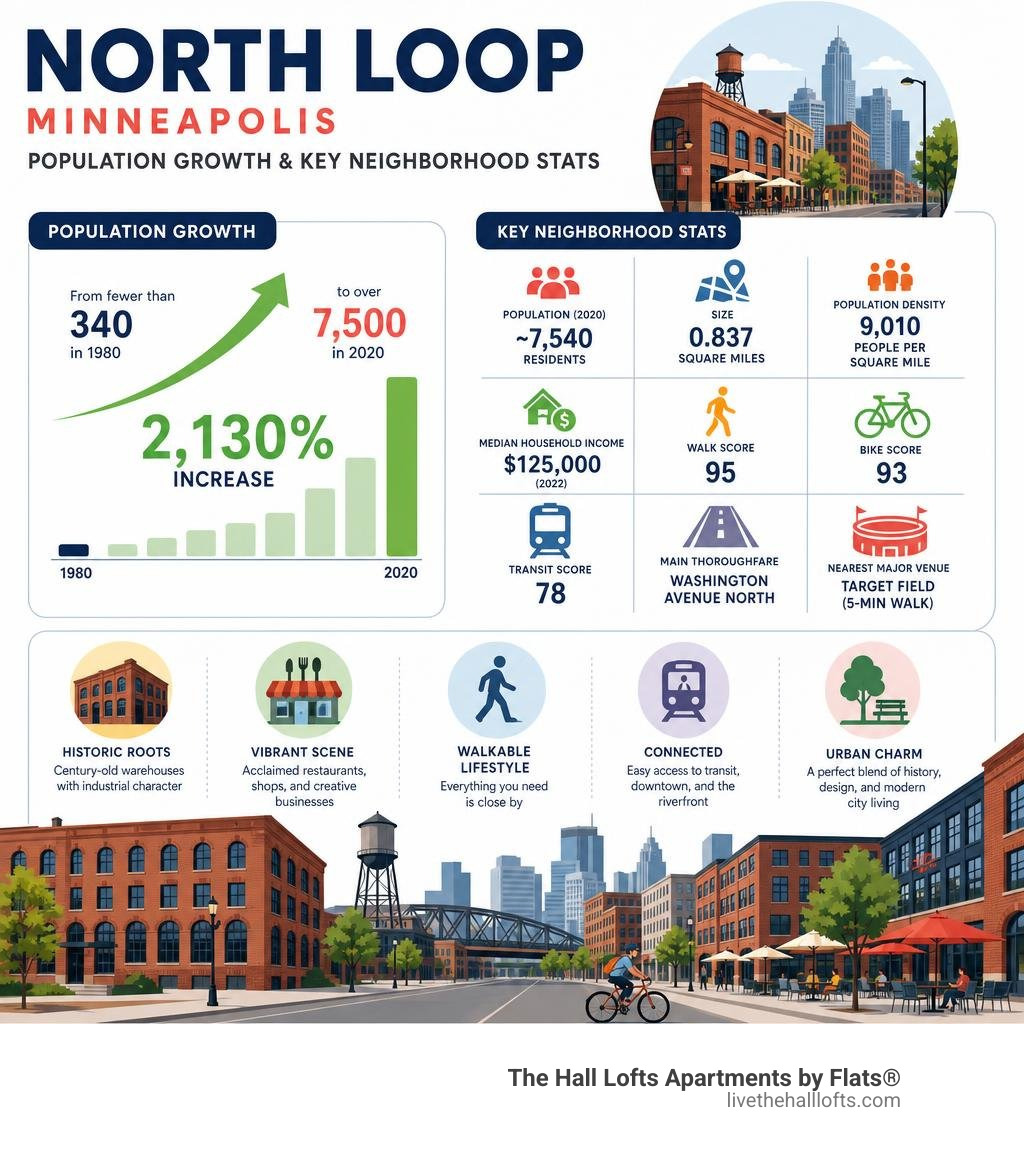
| Population (2020) | ~7,540 residents |
| Population density | 9,010 people per square mile |
| Median household income | $125,000 (2022) |
| Walk Score | 95 |
| Bike Score | 93 |
| Transit Score | 78 |
| Main thoroughfare | Washington Avenue North |
| Nearest major venue | Target Field (5-min walk) |
Located on the northwestern edge of downtown Minneapolis, the North Loop sits where railroad yards and flour mills once defined city life. Today, those same industrial bones — heavy timber frames, exposed brick, soaring ceilings — define some of the most sought-after living and dining spaces in the Twin Cities.
The transformation has been dramatic. In 1980, fewer than 340 people lived here. By 2020, that number had grown to over 7,500 — a 2,130% increase driven by adaptive reuse, proximity to downtown, and a dining and retail scene that draws visitors from across the metro.
Forbes has called it one of America's best hipster neighborhoods. Fodor's lists it among the top places avid travelers should visit. And on a Friday evening, Washington Avenue fills with restaurant patios, gameday crowds, and cyclists in a way that feels less like suburban Minneapolis and more like a dense urban neighborhood from Chicago or Portland.
This guide covers everything worth knowing — the history, the food scene, the housing market, and the transit options.
Geography and History of the Warehouse District
The geographic footprint of the North Loop, Minneapolis is relatively small, yet it contains some of the most historically significant architecture in the Upper Midwest. Bordered by the Mississippi River to the northeast and major transportation corridors on all other sides, the neighborhood functions as a distinct, self-contained pocket of urban life.
Geographic Boundaries and Layout
The neighborhood is bounded by Plymouth Avenue to the north, Hennepin Avenue to the south, Interstate 94 to the west, and the Mississippi River to the northeast.
Unlike the standard cardinal-direction street grid found in much of Minneapolis, the streets in this district run at a 45-degree angle relative to the rest of the city grid. This layout was deliberately aligned with the path of the Mississippi River to facilitate the movement of goods from riverboats and rail lines directly into the industrial facilities.
The primary commercial artery is Washington Avenue North, which runs northwest to southeast through the heart of the district. Other key corridors include 1st Avenue North, 2nd Avenue North, and 3rd Street North, each lined with historic multi-story brick structures.
History and Evolution of the North Loop Neighborhood
In the late 19th century, the area along the Mississippi River rapidly evolved into a major industrial shipping hub. By the 1880s, Minneapolis had become the flour milling capital of the world, with major operations from companies like Pillsbury and Washburn-Crosby (which later became General Mills) lining the riverfront.
To support this massive milling economy, a network of rail lines converged in the area just north of the downtown core. This area became known as the "North Loop" because of the way the streetcar lines and railroad tracks looped around the northern rail yards. Large warehouses and manufacturing plants were built to store, process, and distribute goods.
Architecturally, these buildings were constructed primarily in the Chicago Commercial style, though elements of Victorian, Queen Anne, Richardsonian Romanesque, and Classical Revival styles are also highly visible. Heavy timber framing, thick brick walls, and large multi-paned windows were standard, designed to support the immense weight of stored industrial goods.
As transportation patterns shifted toward interstate highways in the mid-20th century, the rail-dependent industrial district fell into decline. By the 1960s and 1970s, many of the massive warehouse buildings stood empty or underutilized.
During this quiet era, the neighborhood played host to unique community spaces. For example, the Locker Room bathhouse operated in the area from 1969 to 1988, serving as a vital and supportive social space.
By the late 1970s and 1980s, the vast open spaces attracted a burgeoning community of artists, musicians, and designers. The Wyman Building on 1st Avenue North became the epicenter of the local art scene, at one point housing more than twenty contemporary art galleries.
In 1989, the Minneapolis Warehouse Historic District was officially added to the National Register of Historic Places. This designation protected approximately 62 historic structures across seven square blocks, paving the way for the historic preservation tax credits that would fuel the loft conversion boom of the late 1990s and 2000s.
The Unique Appeal of the North Loop Neighborhood
What sets this area apart from other urban enclaves is its exceptional integration of historic preservation and modern commercial vitality. The neighborhood has skipped typical slow-growth cycles, transforming rapidly through deliberate preservation efforts and adaptive reuse. Today, the Neighborhood is home to a thriving ecosystem of creative agencies, technology startups, boutique retail, and world-class dining.
Award-Winning Dining and Craft Breweries
The culinary scene is a major driver of the neighborhood's regional and national reputation. The area features a high concentration of award-winning kitchens, many of which are housed in beautifully restored industrial spaces.
For those exploring the local culinary landscape, the North Loop Minneapolis Restaurants Guide 2026 highlights the sheer variety of options available within a short walk. Fine dining enthusiasts frequently seek reservations at Porzana, a sophisticated destination located in a restored historic building, or other acclaimed local establishments.
The neighborhood is also home to classic dining institutions and innovative new concepts:
- Bar La Grassa: A bustling, high-energy destination known for creative fresh pasta and house specialties.
- Maison Margaux: A multi-level brasserie offering a luxurious atmosphere, a hidden subterranean bar, and classic fare.
- Borough & Parlour: A dual-concept space featuring a refined seasonal restaurant upstairs and a cozy, low-lit basement bar famous for serving one of the most celebrated burgers in the Twin Cities.
- Smack Shack: A casual, high-volume eatery that brought coastal lobster rolls and seafood boils to a restored industrial warehouse.
To discover the full breadth of local dining options, residents and visitors can consult resources like the guide on the Best Restaurants in North Loop Minneapolis or browse the comprehensive list of North Loop Minneapolis Restaurants.
For those seeking specific culinary styles, the neighborhood features premier options such as:
- A classic, high-end experience at a local Steakhouse North Loop.
- Fresh, artfully prepared seafood at a dedicated venue for Sushi North Loop Minneapolis.
- Warm, comforting environments detailed in the Warm Cozy Restaurants North Loop Guide.
- Excellent choices for families outlined in the Kid Friendly Restaurants North Loop MPLS Guide.
For casual dining, visitors can explore the local North Loop Food Trucks or enjoy a meal outdoors on a patio featured in the guide to North Loop Outdoor Dining. For a sweet finish to any meal, local favorites include premium Ice Cream North Loop shops and dedicated options at a Dessert Restaurant North Loop Minneapolis.
The craft beverage scene is equally robust. The district is home to several pioneering breweries and taprooms that offer spacious, pet-friendly outdoor patios:
- Fulton Brewing: One of the original craft breweries in Minneapolis, located just blocks from Target Field, making it a favorite pre-game gathering spot.
- Inbound BrewCo: A spacious, industrial-chic taproom featuring a constant rotation of innovative beers, live music, and a lively community atmosphere.
- Modist Brewing Co: Known for pushing the boundaries of traditional brewing with experimental ingredients and a highly creative art-forward taproom.
Whether looking for a quick bite or planning a multi-course dinner, finding a great North Loop Restaurant Minneapolis or exploring the Restaurants in North Loop MN reveals why this area remains the culinary heart of the city. For late-night drinks, the guide to the Best North Loop Bars offers excellent recommendations, especially for those seeking Dining Near Target Center.
Boutique Shopping and Local Retail
Retail in the neighborhood is characterized by independent boutiques, high-end menswear, and curated home goods stores, many of which cannot be found anywhere else in the state. For a complete directory of local shops, the guide on What to Check Out in the North Loop & Warehouse District is an invaluable resource.
A cornerstone of the local retail scene is MartinPatrick3, a sprawling, internationally recognized store housed in the historic streetcar building. It offers custom menswear, fine jewelry, interior design services, and high-end home furnishings in a meticulously curated environment.
Other notable boutiques include:
- PARC: A minimalist boutique featuring independent designers, contemporary women's apparel, and unique accessories.
- Statement Boutique: A local favorite showcasing curated women's clothing, unique gifts, and jewelry crafted by local artisans.
- Filigree Jewelry: A specialty boutique offering a stunning collection of antique, vintage, and custom-designed engagement rings and fine jewelry.
- James & Mary Laurie Booksellers: A treasure trove for bibliophiles, housing over 120,000 rare and out-of-print books alongside 30,000 vintage vinyl records.
Living and Commuting in the District
Living in the district offers an energetic, highly connected lifestyle. The residential landscape is dominated by adaptive reuse lofts and newly constructed upscale apartment communities that mirror the historic aesthetic of the surrounding area.
To explore the housing options in detail, the Lofts North Loop Minneapolis Guide 2026 provides a deep dive into the unique architectural features of these properties, such as exposed brick walls, original heavy timber beams, and expansive factory-style windows.

For those looking to move to the area, there are diverse options available, ranging from historic conversions to brand-new developments:
- Browse active listings for North Loop Apartments and North Loop Lofts for Rent.
- Explore premium amenities and finishes through North Loop Luxury Apartments.
- Read the curated list of the Best Apartments Minneapolis North Loop 2026.
- Check out nearby residential options just outside the immediate boundary in Apartments Near North Loop.
Getting Around the North Loop Neighborhood
One of the greatest advantages of living in this district is the ability to commute easily without relying on a personal vehicle. With a Walk Score of 95 and a Bike Score of 93, daily errands do not require a car.
The neighborhood is anchored by Target Field Station, a major multi-modal transit hub. This station provides direct access to both the METRO Blue Line (connecting to the airport and the Mall of America) and the METRO Green Line (connecting to downtown St. Paul and the University of Minnesota). It also serves as the terminus for the Northstar Commuter Rail line, which connects the downtown core to the northwestern suburbs.
For cyclists, the neighborhood is exceptionally well-connected. The Cedar Lake Trail runs directly through the district, providing a dedicated, grade-separated bike highway that connects to the wider Chain of Lakes trail system and the Midtown Greenway.
Parks, Recreation, and Outdoor Spaces
Despite its industrial past and dense urban layout, the neighborhood offers excellent access to green spaces and outdoor recreation along the Mississippi Riverfront.
The Grand Rounds Scenic Byway, a 51-mile loop of connected parkways and trails, runs directly along the northeastern edge of the neighborhood, providing paved paths for runners, walkers, and cyclists.
| Park / Trail | Distance from Center | Key Features |
|---|---|---|
| Mississippi Riverfront Trail | Adjacent | Paved paths, historic markers, scenic river views |
| Boom Island Park | 0.8 miles | 28-acre park, boat launch, playground, skyline views |
| The Commons | 1.0 miles | 4.2-acre public green space, community events, lawns |
| North Loop Dog Park | 0.4 miles | Fully fenced, off-leash play area for local dogs |
Frequently Asked Questions
What are the boundaries of the North Loop?
The neighborhood is defined by Plymouth Avenue to the north, Hennepin Avenue to the south, Interstate 94 to the west, and the Mississippi River to the northeast.
Is the North Loop pet-friendly?
Yes, the neighborhood is widely considered one of the most pet-friendly areas in Minneapolis. Most local restaurants with outdoor patios welcome leashed dogs, and the dedicated off-leash dog park near the riverfront is a popular daily gathering spot for residents. Many apartment communities in the area are designed to accommodate pets, typically maintaining a standard two-pet limit per household.
What is the history of the Warehouse District?
The district originated in the late 19th century as a bustling rail and warehousing hub supporting the city's booming flour milling and manufacturing industries. After a period of decline mid-century, it was revitalized by artists in the 1970s and 1980s. In 1989, it was added to the National Register of Historic Places, sparking decades of careful adaptive reuse and residential conversion.
Conclusion
The North Loop represents the very best of modern urban living in Minneapolis. By honoring its rich industrial past while fostering a creative, forward-thinking business and dining community, it has secured its place as one of the most vibrant neighborhoods in the Midwest.
For those seeking to experience this unique lifestyle firsthand, The Hall Lofts Apartments by Flats® offers modern urban living in beautifully renovated warehouse apartments. Combining historic architectural charm with contemporary design, these spaces feature essential modern conveniences such as in-unit laundry and pet-friendly accommodations.